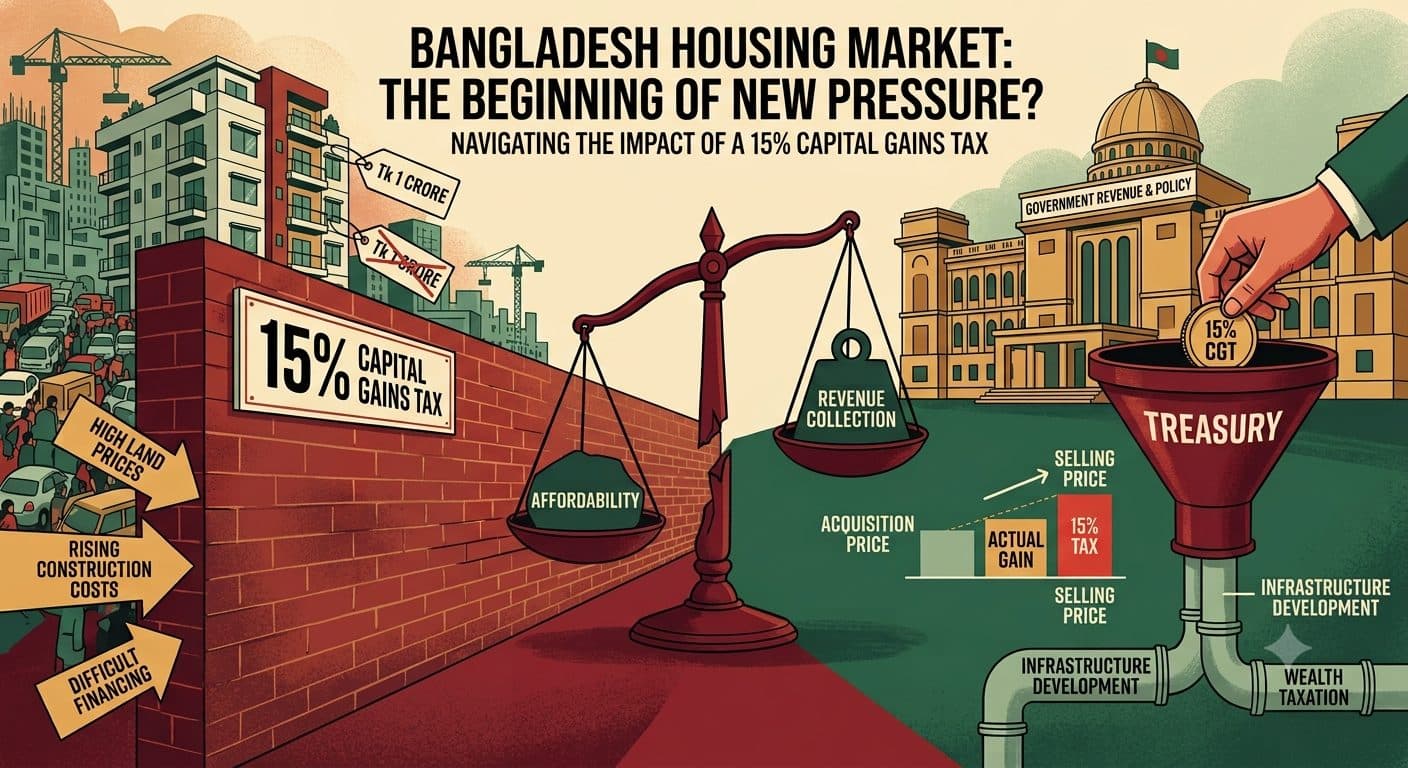
Bangladesh’s real estate market has already been navigating a difficult period. High land prices, rising construction costs, expensive bank financing, declining purchasing power and rapid urbanisation have made homeownership increasingly difficult for many families.
Against this backdrop, the prospect of a 15% capital gains tax on property transactions has raised a new question: could the tax make housing even more expensive in Bangladesh?
The issue is not simply about the tax rate. It is connected to apartment prices, land values, the resale market, developers’ businesses, rental housing and, most importantly, the ability of ordinary people to own a home.
Where Will the Tax Pressure Fall?
Capital gains tax is generally imposed on the profit earned from selling an asset. Therefore, understanding the actual impact of a 15% tax depends first on how it is calculated.
Will the tax be imposed on the entire sale value of a property, or only on the actual capital gain—the difference between the purchase price and the selling price?
That distinction is critical.
In cities such as Dhaka, property values can rise substantially over several years. If a significant tax is imposed on the gain realised when a property is sold, the seller’s net return could decline considerably.
The next question is even more important:
Who ultimately bears that additional cost?
In real estate markets, part of the additional tax burden can potentially be passed from sellers to buyers. If sellers want to maintain their expected net return, they may attempt to increase asking prices.
That is where another layer of price pressure could begin.
Could Apartment Prices Rise Further?
This is perhaps the biggest concern for Bangladesh’s urban housing market.
The price of a new apartment is not determined by construction costs alone. Land prices, building materials, labour, approvals, utilities, financing, marketing and taxation all contribute to the final price.
If an additional tax increases the overall cost of property transactions, the pressure could eventually be reflected in apartment prices.
The impact on developers could be particularly important.
A developer must acquire land, finance construction and manage a range of regulatory and operational costs before an apartment reaches the buyer. If landowners increase their asking prices to compensate for additional tax exposure, developers could face higher land acquisition costs.
Those additional costs may eventually be reflected in apartment pricing.
However, it would be inaccurate to suggest that a 15% capital gains tax would automatically increase apartment prices by 15%.
The actual impact would depend on how the tax is structured, who pays it and how much of the burden can be absorbed by sellers, developers or buyers.
The larger concern is that it could weaken housing affordability.
The Resale Market Could Feel the Pressure First
Bangladesh’s housing market is not limited to newly built apartments. The resale or secondary market is also an important part of the property ecosystem.
Many people buy apartments as long-term investments. Others sell properties after several years because of career changes, migration, family needs or financial requirements.
If a significant capital gains tax applies when these properties are sold, owners may become more cautious about entering the market.
Some may raise their asking prices.
Others may postpone selling altogether.
Some property owners may choose to rent out their apartments instead of selling them.
This could reduce transaction volumes in the resale market.
A paradox could emerge:
Sellers want higher prices, buyers want lower prices, and the tax makes both sides more cautious.
The result could be a market with fewer transactions and lower liquidity.
A New Calculation for the Land Market
Land is the foundation of Bangladesh’s real estate industry.
In and around Dhaka, land prices have increased significantly over the years. As a result, there can be a substantial difference between the original purchase price of a property and its current market value.
If capital gains are taxed, owners may reconsider whether selling is financially worthwhile.
A property owner who believes that a significant portion of the gain will disappear through taxation may simply delay the sale.
That could reduce the supply of land available for transactions.
And real estate markets have a basic economic relationship:
When supply falls while demand remains strong, prices do not necessarily decline. They can rise further.
This could create another layer of pressure on Bangladesh’s already expensive urban property market.
Developers Face Another Challenge
The real estate sector is much larger than apartment buyers and property owners.
It supports thousands of developers, contractors, architects, engineers, interior companies, construction-material suppliers and workers.
Therefore, any policy that increases transaction costs can affect the wider ecosystem.
For developers, one of the largest costs is land acquisition.
If landowners demand higher prices to offset the impact of taxation, developers’ land costs could rise.
At the same time, construction materials, labour costs and financing expenses remain significant.
Developers would then face a difficult choice: raise apartment prices or accept lower profit margins.
If prices rise, affordability suffers.
If profit margins fall sharply, developers may become more cautious about launching new projects.
Neither outcome is particularly favourable for a market that already faces affordability challenges.
Could Rents Rise Too?
The impact on rents would be less direct, but it could still be significant.
If property owners believe selling their assets will result in a substantial tax liability, some may choose to hold their properties and generate rental income instead.
This could become particularly relevant in high-demand areas of Dhaka such as Gulshan, Banani, Dhanmondi, Uttara and Bashundhara.
Whether this would increase or decrease rental supply would depend on how property owners respond to the tax.
But if landlords experience higher costs and lower returns, some may attempt to compensate by increasing rents.
In that case, a tax policy affecting property transactions could eventually reach tenants through higher monthly housing expenses.
The Biggest Concern: Middle-Class Affordability
Perhaps the most important issue is not the tax itself but what it does to affordability.
When a middle-class family plans to purchase an apartment, the actual cost goes far beyond the advertised property price.
Registration expenses, taxes, bank-loan interest, interior work, utility connections and maintenance costs all have to be considered.
If property prices rise further, homeownership could move even further out of reach.
The impact could be particularly strong for young professionals and first-time homebuyers.
Consider a family planning to purchase an apartment worth Tk 1 crore.
If rising land and construction costs, along with taxation, push the price higher, the family may need a larger mortgage.
A larger mortgage means higher monthly instalments.
That creates a chain reaction:
Higher property price → larger loan → higher EMI → lower affordability.
For many middle-income families, that difference could determine whether they buy a home at all.
Will Investors Move Away from Real Estate?
Another important question is investment behaviour.
Real estate has traditionally been one of Bangladesh’s preferred investment avenues. Land and apartments are often viewed as relatively stable, long-term assets.
However, if the tax burden increases significantly, some investors could consider shifting capital toward other asset classes.
That does not necessarily mean real estate investment would suddenly disappear.
Bangladesh remains a rapidly urbanising country with long-term demand for housing and land.
Instead, investor behaviour could change.
Short-term property flipping may become less attractive, while long-term holding could become more common.
Investors who previously bought properties with the intention of selling them after a few years for a profit may become more cautious.
Revenue vs Housing Affordability
There is a legitimate economic argument behind capital gains taxation.
When property values rise and owners generate substantial gains, taxing part of that gain can increase government revenue and strengthen the taxation of wealth and assets.
But the challenge emerges when taxation begins to undermine housing affordability.
Bangladesh is already dealing with a serious housing challenge. Rapid urbanisation, population growth and limited land availability have pushed housing costs upward, particularly in Dhaka.
This creates a delicate policy balance:
How can the government increase revenue without making housing even more expensive?
That may ultimately be the most important question surrounding the proposed tax.
Could a Tax Slow the Market?
Potentially, yes—especially if the overall transaction cost becomes significant.
Three behavioural responses could emerge.
First, sellers may increase prices to recover the cost of taxation.
Second, buyers may delay purchases because properties have become more expensive.
Third, if both sides wait, the number of completed transactions could decline.
This creates an unusual situation in which property prices may remain high while actual transactions fall.
In economic terms, the market could become less liquid—high-value properties remain on the market, but buyers and sellers become increasingly reluctant to transact.
What Could Make the Policy More Effective?
If a 15% capital gains tax is implemented, the structure of the policy will be just as important as the rate itself.
Several questions will matter.
Will the tax apply to the entire sale value or only to the actual capital gain?
Will the length of ownership be taken into account?
Will long-term property owners and short-term speculative investors face the same tax treatment?
Will primary residences receive exemptions?
Will first-time homebuyers or lower-value properties receive special treatment?
These considerations could determine whether the policy strengthens government revenue without creating unnecessary pressure on the housing market.
A poorly structured tax could discourage legitimate transactions, reduce market liquidity and make homeownership more difficult.
A carefully designed system, however, could improve tax compliance while maintaining a healthier property market.
The Road Ahead for Bangladesh’s Real Estate Market
Bangladesh’s real estate sector is approaching a point where balancing investment and affordability has become increasingly important.
The government needs to expand revenue collection and improve transparency in the property market. At the same time, policy decisions should avoid creating a shock that makes homeownership even more difficult or discourages legitimate property transactions.
A 15% capital gains tax, therefore, is not simply a question of a new tax rate.
Its impact will depend on how it is designed, who ultimately pays it and how it interacts with the many other costs already embedded in Bangladesh’s property market.
The bigger question is not whether the tax is 15%.
It is whether the policy can achieve its revenue objectives without pushing apartments, land and rental housing further beyond the reach of ordinary Bangladeshis.
Because the biggest challenge facing Bangladesh’s housing market today is not simply property prices.
It is affordability.