The July sales figures of Chinese electric vehicle manufacturer BYD are more than just a story of corporate success. They offer an important indication of the broader transformation taking place across the global automotive industry.
In July, BYD sold 419,211 vehicles worldwide, marking a 21.8% increase from the same month a year earlier. It was the third consecutive month in which the company recorded year-on-year sales growth.
However, the most significant aspect of the numbers is not simply how many vehicles BYD sold, but where those vehicles are being sold.
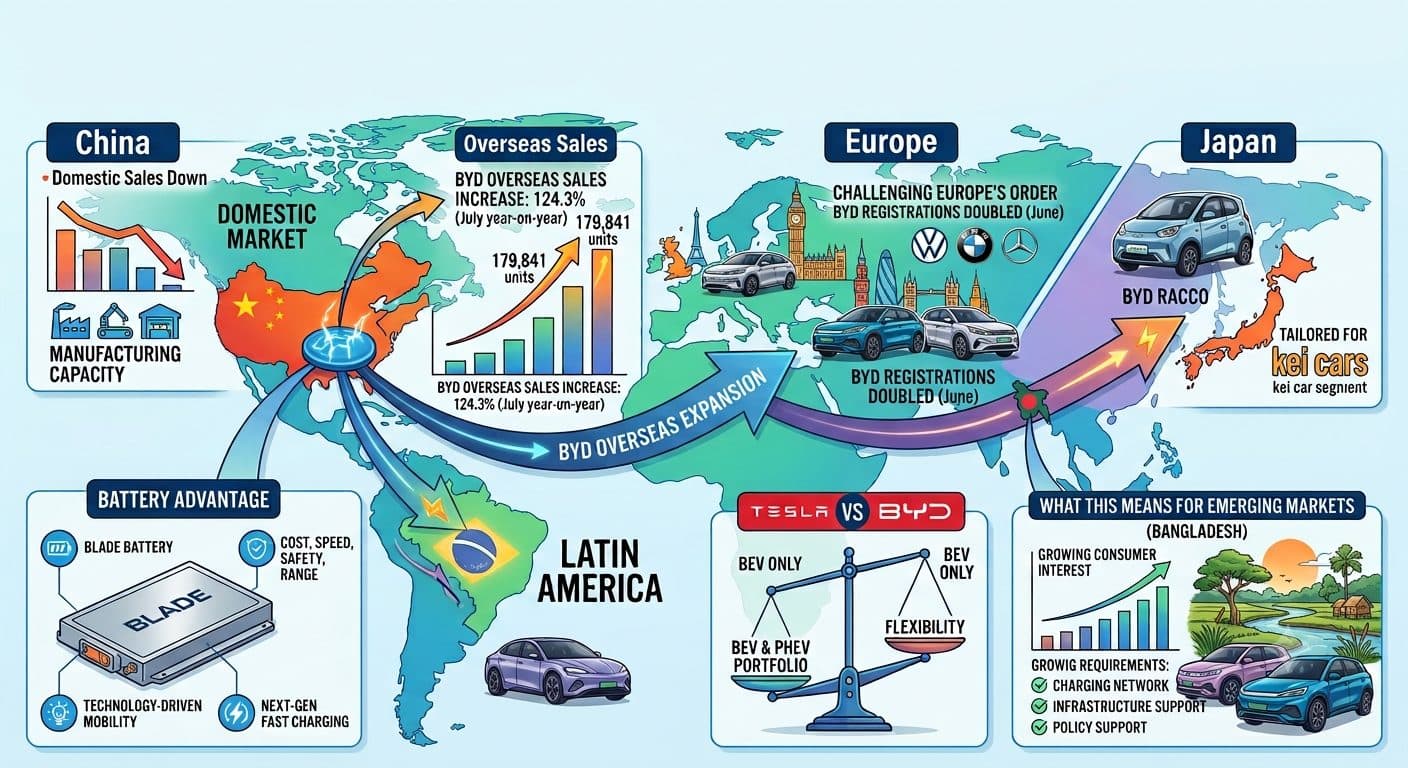
BYD’s overseas sales of passenger vehicles and pickup trucks reached 179,841 units in July, up 124.3% from a year earlier. This means that a growing share of BYD’s momentum is no longer coming solely from the Chinese domestic market. Europe, Asia, Latin America and other international markets are increasingly becoming important growth engines for the company.
Pressure at Home, New Momentum Abroad
To understand BYD’s current position, it is important to look at the realities of China’s automotive market. China is one of the world’s largest electric vehicle markets, but in 2026 the industry has been facing pressure from weaker demand, intense price competition and concerns over consumer confidence.
In June, BYD’s total sales increased by 5.5%, but its domestic sales in China fell by around 22%. At the same time, overseas sales increased by approximately 94.7%.
For BYD, international markets are therefore no longer simply an additional source of revenue. They are becoming one of the company’s most important avenues for sustaining growth.
This shift is significant. For years, one of the biggest advantages of Chinese automakers was the enormous size of their domestic market. Today, they are increasingly using their manufacturing capacity, battery technology and competitive pricing to establish themselves in markets around the world.
Why Is BYD Expanding Overseas So Quickly?
Several factors are working together behind BYD’s international success.
First, years of investment in battery technology have helped transform BYD from a conventional automaker into a technology-driven mobility company. Second, the company has built a broad portfolio covering both fully electric vehicles and plug-in hybrids.
Third, BYD is adapting its products and strategies to individual markets rather than relying on a one-size-fits-all approach.
Japan provides a good example. In late July, BYD entered the Japanese market with its new Racco model, a compact electric vehicle designed specifically for Japan’s popular “kei car” segment—a category that has traditionally been dominated by local manufacturers.
The move demonstrates that BYD is not simply exporting existing models. It is increasingly developing products and strategies around the specific needs and preferences of local markets.
Chinese Automakers Challenge Europe’s Established Order
Europe has become one of the most important destinations for BYD’s international expansion. Historically, the European automotive market has been dominated by established manufacturers such as Volkswagen, BMW, Mercedes-Benz, Renault and Stellantis.
The rise of electric vehicles, however, is rapidly changing that equation.
In June, new BYD vehicle registrations in Europe reached 38,455 units, more than double the figure recorded a year earlier. Other Chinese manufacturers are also expanding rapidly across the continent.
As a result, global automotive competition is no longer limited to traditional battles between European, Japanese and American manufacturers. A new generation of Chinese automakers is now moving to the centre of the global automotive competition.
The UK is another example of BYD’s growing presence. During the first six months of 2026, the company recorded 37,995 new vehicle registrations in the country, representing a 95% increase from the same period a year earlier.
What Does BYD’s Rise Mean for Bangladesh?
The global expansion of BYD and other Chinese automakers is also beginning to have implications for emerging markets such as Bangladesh.
Japanese brands have long dominated Bangladesh’s automobile market, but interest in Chinese electric and hybrid vehicles is gradually increasing. Rising fuel costs, lower running expenses and growing awareness of environmentally friendly mobility are encouraging a section of urban consumers to consider electric vehicles.
BYD’s presence in Bangladesh is an important part of this emerging shift. Interest in its models is growing, while issues such as charging infrastructure, import policies and taxation are becoming increasingly important to the future of electric mobility in the country.
However, wider adoption of electric vehicles in Bangladesh will require more than competitive vehicle prices. The country will need a stronger charging network, reliable electricity infrastructure, a simpler import and registration process, and long-term policy support.
If these areas improve, the global expansion of Chinese EV manufacturers could bring a significant transformation to Bangladesh’s automotive market as well.
Is BYD Becoming a New Challenge for Tesla?
One of the most closely watched aspects of BYD’s rise is its competition with Tesla.
For years, Tesla was widely regarded as the defining name in electric vehicles. Today, however, companies such as BYD, Geely, SAIC, XPeng, Nio, Leapmotor and Xiaomi are increasingly building strong positions in the global EV market.
BYD has a particular advantage because it does not depend entirely on battery-electric vehicles. Alongside fully electric models, plug-in hybrids form an important part of its business.
That gives the company an opportunity to compete in markets where charging infrastructure is still developing and consumers may not yet be ready to make a complete transition to fully electric vehicles.
Yet BYD also faces significant challenges.
Intense price competition in China, changing trade policies, tariffs and political and economic pressure from local manufacturers in overseas markets could make international expansion increasingly complex.
More Than Cars: The Battery Advantage
Looking at BYD purely as a car manufacturer overlooks one of the company’s most important strengths.
Its long-term investment in battery technology has helped differentiate its automotive business from many competitors.
In today’s EV competition, vehicle design and brand image are only part of the equation. Battery cost, charging speed, safety, driving range and manufacturing efficiency are equally important.
A company that can build technological advantages across these areas can gain a significant long-term competitive edge.
BYD is also strengthening its capabilities in fast-charging technology. Advances in next-generation batteries and rapid-charging systems could further improve the company’s competitive position in international markets.
A New Equation for the Global Auto Industry
BYD’s July sales figures are therefore much more than a 21.8% increase in annual sales. They represent a broader shift taking place across the global automotive industry.
Chinese automakers are no longer simply building vehicles for their domestic market. They are designing products for international consumers, adapting models to local preferences, expanding manufacturing capabilities and competing directly with established automotive brands from Europe to Asia.
And at the centre of this competition lies more than just the car itself.
Battery technology, software, charging infrastructure, pricing and manufacturing efficiency are becoming equally important battlegrounds.
For BYD, the biggest question is no longer simply how many vehicles it can sell. The more important question is how many markets it can penetrate and where it can establish itself as a powerful long-term global brand.
The July numbers suggest that BYD’s journey beyond China is already well underway.